AFAD 2024-2028 Strategic Plan: Integrated Disaster Risk Management, Legislative Reform, and Technological Capacity Analysis
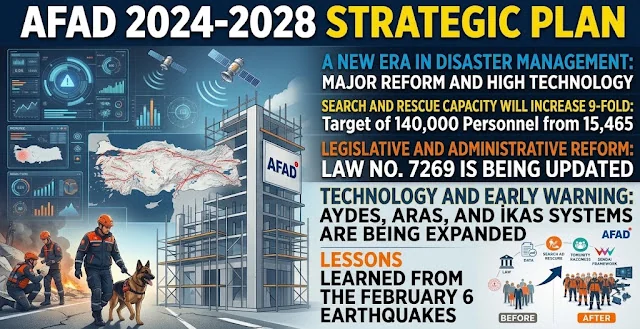
A detailed technical review of the Republic of Türkiye Ministry of Interior Disaster and Emergency Management Authority (AFAD) 2024–2028 Strategic Plan. This overview focuses on policy alignment, legislative modernization, decision-support architecture, operational metrics, and the 66 KPIs driving a 15.47 Billion TRY investment toward disaster resilience.
On this page
- From Sendai to the Field: A Constructive Overview of Türkiye's AFAD 2024–2028 Strategic Roadmap
- 1. Global and National Policy Alignment
- 2. Institutional Framework and Legislative Evolution
- 3. The Integrated Disaster Management Plan Chain
- 4. Decision-Support, Early Warning, and Communication Technologies
- 5. Operational Field Data: The February 6 Earthquakes as a Stress Test
- 6. Performance Indicators and Budget Allocation
- 7. Constructive Takeaways for International DRR Practitioners
- References & Primary Sources
Tags: Policy & DRR Framework
From Sendai to the Field: A Constructive Overview of Türkiye's AFAD 2024–2028 Strategic Roadmap
A detailed technical review of the Republic of Türkiye Ministry of Interior Disaster and Emergency Management Authority (AFAD) 2024–2028 Strategic Plan. This overview focuses on policy alignment, legislative modernization, decision-support architecture, operational metrics, and the 66 KPIs driving a 15.47 Billion TRY investment toward disaster resilience.
1. Global and National Policy Alignment
The AFAD 2024-2028 Strategic Plan is structured to translate the high-level objectives of the Sendai Framework and the 12th Development Plan into measurable disaster management outcomes. Preparation began in June 2022 under the guidelines of the Presidential Strategy and Budget Office (SBB), ensuring vertical alignment between macroeconomic development targets and ground-level risk reduction operations.
2. Institutional Framework and Legislative Evolution
A key focus of the plan is the modernization of the foundational legislative framework. The plan explicitly acknowledges that current operational structures—still partially based on Laws No. 7269 and 7126 (enacted in 1959)—require comprehensive updating to align with contemporary integrated disaster management principles.
A. Addressing Jurisdictional Overlaps
The plan recognizes the need to resolve authorization conflicts between AFAD and the Ministry of Environment, Urbanization and Climate Change (ÇŞİDB) regarding site-selection, urban planning, and inspection processes to streamline post-disaster reconstruction.
B. Revising the Disaster Services Law
Recognizing that Law No. 7269 requires a comprehensive overhaul, the plan initiates work to transform it into a modern "Services Law" that reflects current administrative and technological realities.
C. Improving Stakeholder Legal Status
To enhance operational efficiency, the plan targets legal clarifications for AFAD volunteers and accredited NGOs—particularly regarding labor law protections during emergency deployments—supporting stronger public-private coordination.
3. The Integrated Disaster Management Plan Chain
AFAD's operational continuity relies on a three-tiered plan structure that connects risk reduction, emergency response, and recovery. This ecosystem ensures that pre-disaster mitigation efforts are directly linked to post-disaster reconstruction.
- Preventive Phase (TARAP & İRAP): The Türkiye Disaster Risk Reduction Plan (TARAP) and 81 Provincial Disaster Risk Reduction Plans (İRAP) were completed in 2021, identifying 12,890 concrete risk-reduction actions at the local level.
- Emergency Response Phase (TAMP): The modular Türkiye Disaster Response Plan (TAMP) and Provincial Response Plans coordinate service groups and define solution-partner institutions for streamlined command and control.
- Recovery Phase (TASİP): The newly drafted Türkiye Post-Disaster Recovery Plan (TASİP) standardizes procedures for permanent housing, entitlement identification, and infrastructure rehabilitation to ensure rapid normalization.
4. Decision-Support, Early Warning, and Communication Technologies
AFAD's technological infrastructure underpins real-time situational awareness. The ecosystem features several proprietary platforms designed for interoperability and resilience.
AYDES (Disaster Management & Decision Support)
The eTR award-winning backbone of TAMP. Integrates GIS and Remote Sensing technologies with over 500 spatial data layers across desktop, web, and mobile platforms.
ARAS (Disaster Risk Reduction System)
Centralized hazard modeling platform operating across 81 provinces, housing national inventories for landslides, rockfalls, avalanches, and sinkholes.
HAY & İKAS (Mass Warning & Siren Networks)
HAY broadcasts emergency alerts via SMS, CMAS, and mobile apps. İKAS deploys domestically produced siren hardware across all 81 provinces.
ORKA, EATS & TDVMS
ORKA establishes wide-area digital radio communication. EATS tracks 87,135 response vehicles in real-time. TDVMS processes data from 1,187 seismic stations 24/7.
Administrative operations are supported by AFBİS, EBYS, the Uninterrupted and Secure Communication System (KGHS), and full open-source Pardus OS deployment across all provincial directorates.
5. Operational Field Data: The February 6 Earthquakes as a Stress Test
The February 6, 2023 Kahramanmaraş earthquakes were a critical stress test for AFAD's systems. The operational data gathered from this event directly informed the baseline metrics for the 2024–2028 strategic targets.
Verified Operational Metrics from the February 6, 2023 Earthquakes
35,250
SAR Personnel (11,488 Intl.)
650,000
Total Personnel Deployed
17,500
Air Sorties (Heli / Planes)
1,000,000+
Tents Dispatched
Field Logistics: 141 helicopters, 182 aircraft, 23 vessels, and 20,000 vehicles were mobilized. 312 mobile kitchens delivered an average of 4 million meals per day.
Temporary Shelter: 645,000 tents erected across 350 camps temporarily housed ~2.5 million people, while 1,188,218 survivors were hosted in KYK (477,952) and MEB (710,266) student dormitories.
Recovery: Debris from all 60,421 collapsed buildings was fully cleared. Across 18 provinces, 845,371 entitlement claims were evaluated, resulting in 441,741 final beneficiaries.
6. Performance Indicators and Budget Allocation
The AFAD 2024-2028 Strategic Plan commits to 66 quantitative targets with a weighted allocation toward risk reduction and response capacity, prioritizing a proactive stance.
Selected Key Performance Indicators (Baseline 2023 → Target 2028)
| Code | Indicator | Baseline (2023) | Target (2028) |
|---|---|---|---|
| PG1.1.1 | Uninterrupted uptime of seismic observation stations | 85% | 95% |
| PG1.3.1 | Area mapped using remote sensing (km², cumulative) | 0 | 50,000 |
| PG1.4.1 | Implemented structural prevention projects | 10 | 100 |
| PG2.1.1 | Citizens reached through awareness training | 87 Million | 112 Million |
| PG2.3.3 | Completion of Türkiye Disaster Management Strategy Document | 10% | 100% |
| PG3.2.1 | Regional/National drills conducted | 0 | 30 |
| PG3.3.1 | Provinces equipped with Digital Radio System | 46 | 81 |
| PG3.3.4 | Trained SAR personnel (cumulative) | 15,465 | 140,000 |
| PG4.1.3 | Identification of temporary shelter reserve areas | 0% | 100% |
| PG4.2.1 | Operational logistics warehouses | 81 | 100 |
| PG6.6.4 | National disaster data management standards & system | 0% | 100% |
Estimated Budget by Strategic Goal (2024–2028)
| Goal | Focus Area | Budget (TRY) | Approx. (USD)* |
|---|---|---|---|
| Goal 1 | Risk Reduction Effectiveness | 5,254,500,000 | ~$164M |
| Goal 2 | Public & Institutional Preparedness | 466,250,000 | ~$15M |
| Goal 3 | Emergency Response & Coordination | 4,966,400,000 | ~$155M |
| Goal 4 | Post-Disaster Recovery & Shelter | 605,000,000 | ~$19M |
| Goal 5 | International Humanitarian Presence | 3,284,420,000 | ~$103M |
| Goal 6 | IT, Infrastructure & HR Capacity | 897,200,000 | ~$28M |
| TOTAL | 15,473,770,000 | ~$480M |
*USD equivalents are indicative conversions at the ~32 TRY/USD exchange rate prevailing during the plan’s announcement period in 2024, provided solely for international contextual reference; actual execution budgets are denominated in TRY.
7. Constructive Takeaways for International DRR Practitioners
Türkiye's roadmap offers valuable benchmarks for nations enhancing their disaster resilience frameworks. The plan demonstrates a clear institutional commitment to moving beyond reactive measures toward predictive and preventive capacity.
1. Scalable Capacity Building
The goal of expanding certified SAR staff from 15,465 to 140,000 represents a roughly 9-fold increase, addressing the critical need for state-wide, structured responder mobilization.
2. Proactive Legislative Governance
The explicit focus on overhauling 65-year-old disaster legislation reflects a strategic recognition that modern IT tools (AYDES/ARAS) require aligned administrative law to function effectively.
3. Investment in Prevention
Allocating approximately 34% of the total strategic budget to risk reduction (Goal 1) demonstrates a concrete shift toward Sendai Framework Priority 3: investing in disaster risk reduction for resilience.
References & Primary Sources
All quantitative figures in this overview are drawn directly from the official AFAD 2024–2028 Strategic Plan and cross-checked against the primary sources below.
References
- Disaster and Emergency Management Authority (AFAD) Strategic Plans (2024–2028). T.C. Ministry of Interior. afad.gov.tr/stratejik-planlar
- AFAD AFAD 2024–2028 Strategic Plan Published (official announcement). afad.gov.tr/afad-2024-2028-stratejik-plani-yayimlandi
- Presidential Strategy and Budget Office (SBB) Strategic Plan 2024–2028. sbb.gov.tr (PDF)
- United Nations Office for Disaster Risk Reduction (UNDRR) Sendai Framework for Disaster Risk Reduction 2015–2030. undrr.org
- UNDRR What is the Sendai Framework for Disaster Risk Reduction? (four priorities & seven targets). undrr.org/implementing-sendai-framework
Frequently asked questions
What is the primary reference framework for the AFAD 2024–2028 Strategic Plan?
The plan is fundamentally aligned with the UN Sendai Framework for Disaster Risk Reduction (2015–2030) and structured to meet the disaster-specific measures outlined in Türkiye's 12th Development Plan (2024–2028).
How does the plan address historical legislative challenges?
The plan identifies the need to modernize foundational laws (dating back to 1959) to resolve jurisdictional overlaps—particularly between AFAD and spatial planning authorities—and initiates a legislative update roadmap to establish a modern 'Services Law' framework.
What are the core operational plans structuring AFAD's approach?
AFAD operates through a three-tiered structure: TARAP & İRAP for pre-disaster risk mitigation, TAMP for coordinated emergency response, and TASİP for structured post-disaster recovery.
What technological systems support AFAD's integrated management?
The ecosystem relies on the AYDES GIS-based decision support system, the ARAS hazard mapping platform, HAY & İKAS for mass early warnings, and ORKA for inter-agency digital radio communication.
How did the February 6, 2023 earthquakes influence the plan's targets?
Field data from the Kahramanmaraş earthquakes—mobilizing 650,000 personnel and over 1 million tents—directly informed the plan’s quantitative targets, including the roughly 9-fold expansion of certified SAR personnel and comprehensive temporary shelter reserve mapping.
No comments yet. Be the first.