From Analog to Digital: How Türkiye Built Europe's Largest Seismic Network
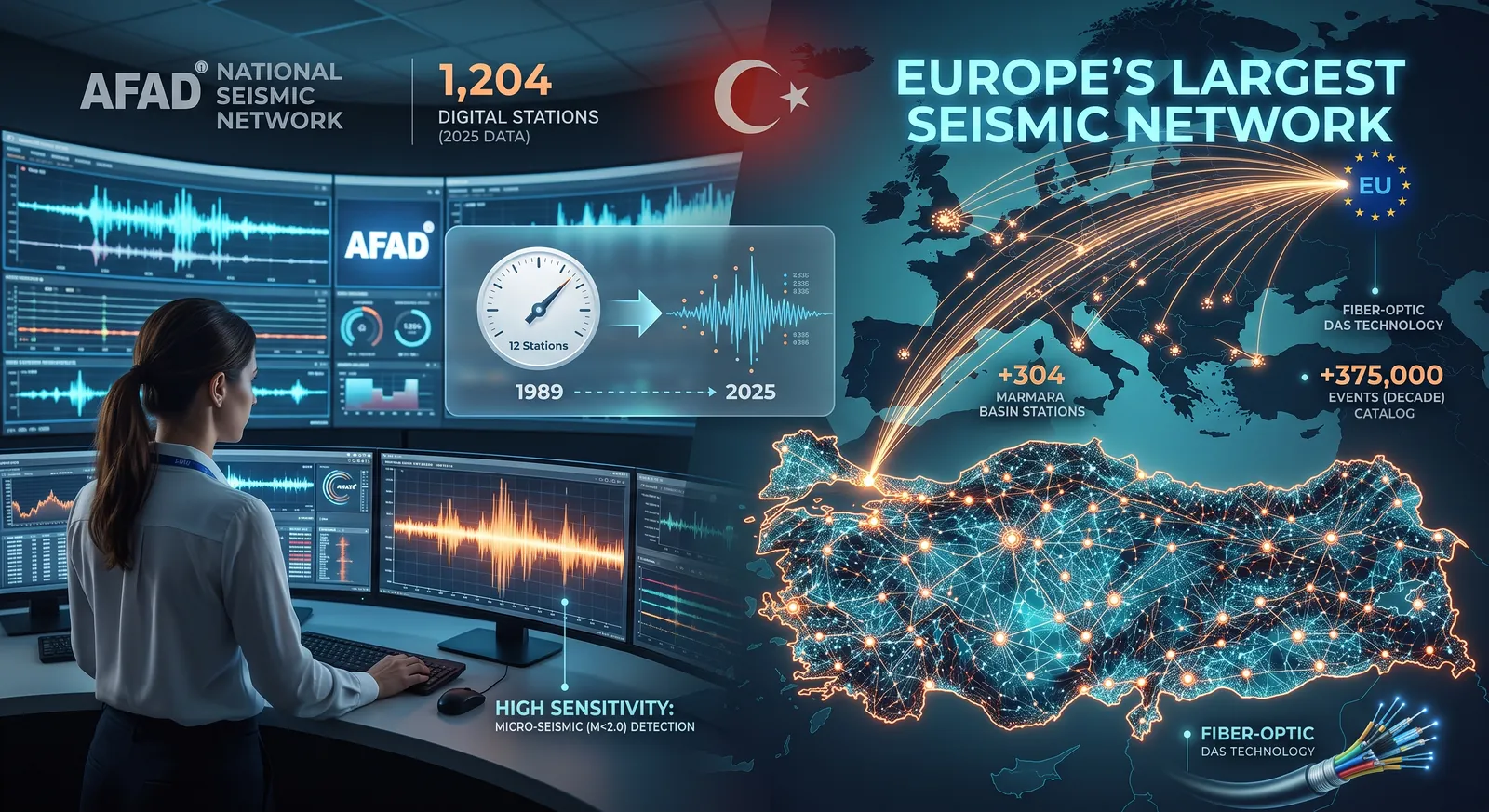
Continuous high-resolution data acquisition is the backbone of disaster risk management. Drawing on official data from AFAD and statements by its Director General for Earthquake and Risk Reduction, Prof. Dr. Orhan Tatar, this analysis traces Türkiye's transition from 12 analog stations in 1989 to an integrated digital network of 1,204 observation points in 2025.
Türkiye has expanded its seismic observation network from approximately 12 analog devices in 1989 (and ~20 in 1999) to 1,204 digital stations as of 2025, making it the largest seismic monitoring network in Europe by count. Managed 24/7 by AFAD using proprietary national software, the network features multi-parametric monitoring in the Marmara region (304+ stations), cross-border technology transfer to the TRNC, and rapid 5 to 10 minute manual earthquake verification protocols. The network's high sensitivity allows the detection of micro-seismic events (M<2.0), contributing to a decade-long catalog of approximately 375,000 events.
- Türkiye expanded its seismic monitoring network from 12 analog stations in 1989 (and ~20 in 1999) to 1,204 digital stations by 2025.
- The 1,204-station infrastructure forms the largest integrated seismic observation network in Europe as of 2025.
- The Marmara basin is monitored by over 300 stations, including broadband seismometers, strong-motion accelerometers, deep borehole sensors, and fiber-optic Distributed Acoustic Sensing (DAS) via a protocol with Türk Telekom.
- AFAD recorded approximately 375,000 seismic events across all 81 provinces over the past decade. (Methodological note: This figure includes low-magnitude micro-earthquakes [M<2.0], reflecting the network's high sensitivity rather than solely major ruptures.)
- Initial automated solutions are manually verified and published by AFAD seismologists within 5 to 10 minutes.
- AFAD's annual earthquake processing capacity has reached approximately 25,000 events, supported by proprietary national software.
On this page
- The Quantitative Shift: From 12 Analog Units to 1,204 Digital Stations
- Network Resolution and the 375,000 Earthquakes Metric
- Heterogeneous Monitoring in the Marmara Basin
- Proprietary Software and Cross-Border Technology Transfer
- Executive Briefing: Video Presentation
- Implications for Disaster Risk Reduction (DRR)
The Quantitative Shift: From 12 Analog Units to 1,204 Digital Stations
According to Prof. Dr. Orhan Tatar, Director General for Earthquake and Risk Reduction at AFAD, the foundation of Türkiye's modern seismic network began with just 12 analog stations established in 1989. Prior to the devastating August 17, 1999 East Marmara earthquake, this network had only grown to approximately 20 analog stations. The analog infrastructure imposed severe operational constraints, including transmission latency and poor spatial resolution, critically hindering dynamic decision support during emergency response.
Evolution of Türkiye's Seismic Observation Network (1989-2025)
| Period / Year | Station Count | Infrastructure Type | Operational Scope |
|---|---|---|---|
| 1989 (Initial Setup) | 12 | Analog Systems | Foundational network with limited national coverage |
| Pre-1999 (Pre-Marmara) | ~20 | Analog Systems | Sparse coverage with delayed manual readings |
| 2005 (Post-Expansion) | 433 | Digital Transition Phase | Rapid station deployment and central network integration post-1999 |
| 2023 (Large-Scale Array) | 1,145 | Large-Scale Digital Array | Multi-component monitoring and strong-motion expansion |
| 2025 (Present Network) | 1,204 | Multi-Parametric Network | Largest integrated seismic observation network in Europe |
Prof. Dr. Orhan Tatar emphasized that operating 1,204 active stations positions Türkiye as the operator of the largest seismic observation network in Europe as of 2025. The real-time telemetry stream is evaluated around the clock by the AFAD National Earthquake Monitoring and Evaluation Center through a structured operational protocol. Furthermore, AFAD has reached an annual processing capacity of approximately 25,000 earthquake solutions, fully utilizing its proprietary national software.
Network Resolution and the 375,000 Earthquakes Metric
Prof. Dr. Tatar reported that over the past decade, AFAD recorded approximately 375,000 seismic events across the country. This seismicity spans all 81 provinces, underlining the necessity of nationwide structural and territorial risk reduction policies rather than localized interventions alone.
Heterogeneous Monitoring in the Marmara Basin
The western branches of the North Anatolian Fault Zone beneath the Marmara Sea require intensive, multi-parametric observation. According to AFAD data, the Marmara basin is instrumented with 304 active monitoring stations that combine complementary sensor technologies to capture crustal deformation and seismic activity with unmatched precision.
Broadband Seismometers
Strong-Motion Accelerometers
Deep Borehole Stations
Fiber-Optic DAS & Strainmeters
Proprietary Software and Cross-Border Technology Transfer
To process massive telemetry feeds without external software dependencies, AFAD utilizes proprietary national seismic evaluation and network management software. This technical infrastructure directly supports regional capacity-building initiatives. Prof. Dr. Tatar confirmed the successful technology and software transfer to the Turkish Republic of Northern Cyprus (TRNC), alongside the installation of new surface and deep borehole stations on the island. Technical data achieves operational value when connected directly to end-user preparedness. This operational bridge is maintained through mobile simulation training units, the public education platform hazirim.gov.tr, and the AFAD Earthquake mobile application, which distributes verified notifications and directs citizens to designated emergency assembly areas.
Executive Briefing: Video Presentation
Watch the official overview from the AFAD National Earthquake Monitoring and Evaluation Center below (with automated English captions enabled): Watch Video Briefing: Türkiye's National Earthquake Monitoring Center
Implications for Disaster Risk Reduction (DRR)
Building and operating a 1,204-station digital array establishes a world-class observation capacity. In the disaster risk management lifecycle, high-resolution data fulfills its purpose only when directly integrated into urban planning, structural health monitoring, geotechnical microzonation, and community resilience programs. AFAD continues to lead these efforts under the coordination of the Disaster and Emergency Management Presidency, reinforcing Türkiye's commitment to reducing seismic vulnerability.
References
- Anadolu Agency (1 May 2025) News report on Türkiye monitoring ground motion with over 1,200 seismic stations, including statements on annual processing capacity.
- TRT Haber (1 May 2025) Statement by Prof. Dr. Orhan Tatar confirming Türkiye operates Europe's largest observation network as of 2025.
- Anadolu Agency (12 Jan 2025) Report on AFAD's deep borehole station installations and software transfers to the TRNC.
- Hürriyet (21 Sep 2023) Earlier coverage of AFAD's seismic monitoring scale, referencing 1,145 stations.
- AFAD Institutional Portal Official documentation on national earthquake observation network architecture and station distribution.
- RESMAR Project (Steering Committee) First Steering Committee Meeting documentation for the Marmara Subsea Seismic Monitoring Project (August 29, 2025), focusing on industrial resilience and continuity.
Frequently asked questions
How many earthquake monitoring stations does Türkiye operate in 2025?
Türkiye operates 1,204 active digital seismic observation stations across all 81 provinces as of 2025, managed 24/7 by the AFAD National Earthquake Monitoring and Evaluation Center.
Why is the Marmara region monitored with specialized sensors?
Due to high seismic risk along the North Anatolian Fault Zone beneath the Sea of Marmara, the basin uses over 300 stations equipped with broadband seismometers, strong-motion accelerometers, strainmeters, deep borehole sensors, and fiber-optic Distributed Acoustic Sensing (DAS) technology integrated via Türk Telekom's seabed cables.
What does the 375,000 recorded earthquakes metric indicate scientifically?
The figure reflects the network's high sensor density and sensitivity, effectively lowering the magnitude threshold. It allows the detection of micro-seismic events (M < 2.0) nationwide, providing a comprehensive baseline of background seismicity rather than just indicating major fault ruptures.
No comments yet. Be the first.