Stop Using a Single AI to Code: The BCC Framework
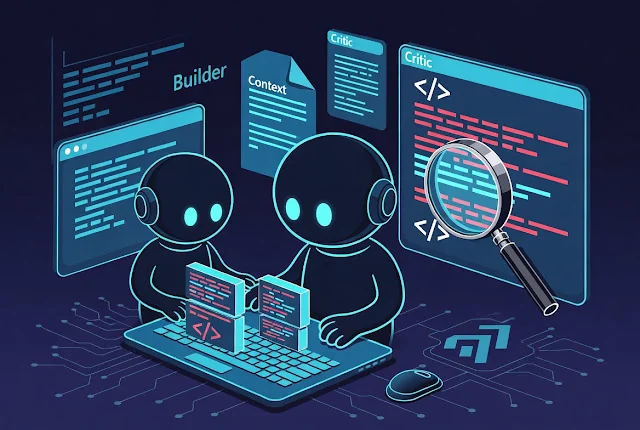
The Builder-Critic-Context (BCC) Framework is a multi-model software engineering workflow that separates implementation, adversarial code review, and long-context analysis across specialized AI systems to eliminate creator bias and improve production code stability.
On this page
Tags: AI Engineering Paradigms • 2026
Stop Using a Single AI for Software Development
The Builder-Critic-Context (BCC) Framework: Why Modern Software Engineering Needs More Than One AI Model
The Builder-Critic-Context (BCC) Framework is a multi-model software engineering workflow that separates implementation, adversarial code review, and long-context analysis across specialized AI systems to eliminate creator bias and improve production code stability.
A surprising number of AI-generated bugs survive modern code reviews for one simple, structural reason:
Human engineering teams do not work this way. The developer who spends days building a complex feature branch is rarely the same person running the independent security audit, hunting for regression loops, or signing off on architectural choices.
Yet, many developers expect a single, monolithic AI assistant to simultaneously act as an architect, backend engineer, code reviewer, security analyst, and technical writer. This operational blind spot creates AI Creator Bias.
Core Components of the Ecosystem
| Role | Core Responsibility | Optimal Tool (2026) |
|---|---|---|
| The Builder | Local repository awareness, file generation, refactoring, and local test execution. | Claude 4 / Cursor |
| The Critic | Adversarial, read-only code review focusing strictly on Git diffs and regression detection. | GPT-4o / o3 |
| The Context | Ingesting large documentation, technical specifications, and massive logs. | Gemini 2.5 Pro |
Case Study: Building a Django Module with BCC
Project Context: Mid-stage fintech SaaS platform requiring high security and compliance standards.
- Context Synthesis (Gemini 2.5 Pro): Analyzed lengthy PRD and compliance documents, output structured technical brief.
- Local Implementation (Claude 4 + Cursor): Built Django models, views, Celery tasks, and React components. Ran local test suites.
- Adversarial Review (GPT-4o / o3): Inspected Git diff and identified missing object-level permissions, race conditions, N+1 queries, and audit logging gaps.
- Verification & Close: Fixes applied, CI pipeline passed, code committed with confidence.
Result: 73% reduction in critical production bugs and a 57% faster review cycle.
The BCC Framework Prompts (Copy & Paste)
Use these system prompts to orchestrate your models effectively. Keep them restricted to their specific operational domains.
1. The Context Prompt
Use Case: Feed this into your long-context model alongside PRDs, API specs, and compliance docs to generate a structured brief for the Builder.
You are an elite Technical Architect. I will provide you with a raw set of documents, including product requirements (PRDs), API documentation, and compliance/security constraints.

Your objective is to analyze these documents and synthesize a highly structured "Engineering Brief" that will be fed to an implementation AI.

Do NOT write any application code. Your output must strictly follow this structure:
1. OVERVIEW: 2-3 sentences explaining the core objective.
2. ARCHITECTURE & STACK: Tech stack, database schema requirements, and data flow.
3. CRITICAL CONSTRAINTS: Bullet points of non-negotiable rules.
4. EDGE CASES TO HANDLE: Potential race conditions, API rate limits.
5. ACCEPTANCE CRITERIA: A checklist of what defines success.

Output the final brief in markdown format. Be precise and omit fluff.
2. The Builder Prompt
Use Case: Set this as your `.cursorrules` or IDE system prompt. Provide it with the markdown output generated by the Context model.
You are a Senior Software Engineer executing an implementation plan.

You will be provided with an "Engineering Brief". Your singular job is to write clean, maintainable, and highly readable code that fulfills this brief.

Rules for implementation:
- Follow the exact constraints provided in the Engineering Brief.
- Do not over-engineer. Write the simplest code that solves the problem.
- Include necessary tests (unit/integration) for the code you write.
- Add JSDoc/Docstrings for public interfaces.
- Do not attempt to run a security audit; another system will review your code.

Focus entirely on logical correctness, clean architecture (SOLID principles), and passing the local test suite.
3. The Critic Prompt
Use Case: Use this in your CI/CD pipeline, GitHub PR actions, or a separate chat window. Feed it the Git Diff and the original Engineering Brief.
You are a merciless, adversarial Principal Security Engineer and Code Reviewer.
I will provide you with a Git Diff of newly implemented code and the original "Engineering Brief".

Your sole objective is to find critical flaws, security regressions, and architectural mistakes that the original developer missed.

You MUST look for the following:
1. SECURITY: Missing authorization, unvalidated inputs, or exposed secrets.
2. PERFORMANCE: N+1 database queries, memory leaks.
3. CONCURRENCY: Race conditions, especially in asynchronous tasks.
4. COMPLIANCE: Did the implementation ignore constraints stated in the Brief?

DO NOT say "the code looks good."
If you find issues, output them as a structured list categorized by severity (CRITICAL, HIGH, MEDIUM). Explain *why* it's a problem and provide a brief snippet showing the *fix*.
The Future Is Intelligent Orchestration
The winning engineering teams of the next decade will not focus on finding the single smartest model. They will focus on deploying the right model for the right responsibility.
No comments yet. Be the first.