From Fear-Based Risk to the Sendai Frame: What Integrated CBRN Risk Management Still Needs
On this page
- Why "fear-based risk" is the right starting point
- Bridge 1 — The Sendai Framework already did this work
- Bridge 2 — Those industrial accidents have a name: Natech
- Bridge 3 — The biological dimension is wider than bioterrorism
- Where this leaves the integrated model
- Frequently asked questions
- References
Disaster Risk Reduction · Analysis
A recent AFAD study makes a strong case that chemical, biological, radiological and nuclear threats belong inside disaster risk management — not beside it. Building on that argument, three international frameworks can turn a national case into a globally legible model.
Why "fear-based risk" is the right starting point
CBRN hazards occupy a peculiar corner of risk. They are hard to detect, their exposure outcomes are uncertain, and contamination effects arrive on a delay. Because of that combination — lethality, poor controllability, and the capacity to trigger large-scale catastrophe — the literature classifies them as fear-based risks. This is an accurate and useful framing, because the thing that actually amplifies a CBRN event is rarely the agent alone; it is the public's perception, the speed and credibility of official warnings, and the social response that follows.
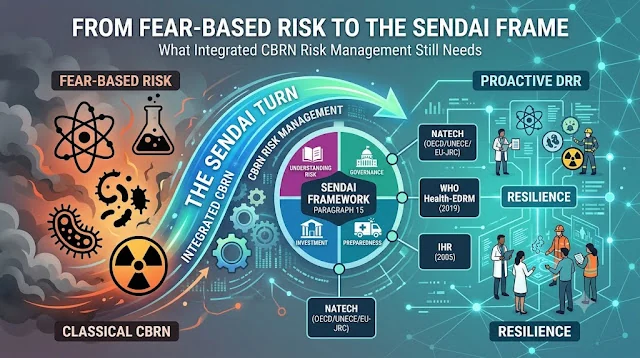
The practical consequence is that CBRN risk cannot be handed to a single ministry or a single uniformed service. It requires the integration of regional, national and international strategy, and the active participation of defense, law enforcement, intelligence, civil protection, health, research, civil society and industry. This is the heart of the transformation from classical risk management — a linear, reactive, largely technical process — to integrated risk management, which is proactive and reactive at once and rests on four phases: preparedness, mitigation, response and recovery.
So far, so sound. The question this analysis asks is: what would make that argument travel? What connects a well-reasoned national case to the frameworks the global DRR community already speaks? Three bridges stand out.
Bridge 1 — The Sendai Framework already did this work
The strongest available anchor for an "integrated CBRN risk management" thesis is one that national studies frequently leave unused: the Sendai Framework for Disaster Risk Reduction 2015–2030. Its scope is not limited to earthquakes and floods. Adopted by UN member states in 2015, the framework applies explicitly to "small-scale and large-scale, frequent and infrequent, sudden and slow-onset disasters, caused by natural or man-made hazards, as well as related environmental, technological and biological hazards and risks" (paragraph 15).
That single sentence is the intellectual foundation an integrated-CBRN argument needs. It means CBRN is not being imported into disaster management as a courtesy — it is already inside the tent by definition. The UNDRR–ISC Hazard Definition and Classification Review went on to classify more than 300 hazard types across exactly this extended range, giving practitioners a shared vocabulary for chemical, radiological, nuclear and biological events.
The Sendai turn also reframes the four-phase model. Sendai's four priorities for action — understanding risk, strengthening risk governance, investing in resilience, and enhancing preparedness for "Build Back Better" recovery — map cleanly onto preparedness, mitigation, response and recovery. Presenting the national model against that backdrop does two things at once: it validates the phase structure and it makes the whole argument legible to any DRR audience from Geneva to Jakarta.
A caveat keeps this honest, though. Sendai covers CBRN on paper; the harder problem lives in practice. Intelligence and security agencies run on a confidentiality reflex — need-to-know, compartmentalization, controlled disclosure — while civilian disaster management runs on the opposite instinct: transparency, rapid warning, and information shared fast enough to save lives. Those two cultures collide precisely at the moment a CBRN event demands both. The point of integration is not to dissolve that tension by putting everyone in the same uniform; it is to bridge the information silos with a common risk language, so that a security service and a provincial civil-protection team can at least mean the same thing by the same terms when minutes matter.
And the place those silos become most visible is not the abstract threat — it is the very concrete moment a natural hazard slams into an industrial site.
Bridge 2 — Those industrial accidents have a name: Natech
Any honest account of technology-driven disaster risk in an industrialized, seismically active country will list the accidents. A fireworks-factory explosion. A cyanide-laden heap-leach collapse at a gold mine. A grain-silo blast. A chemical-plant fire. Each is real; each is serious. But listed without a unifying concept, they read as a catalogue rather than a category.
The category exists. Natech — Natural Hazard Triggered Technological accidents — describes exactly the cascade where a natural hazard strikes a facility that stores or handles hazardous substances, producing releases, fires or explosions. The term is not academic decoration: it sits at the center of a mature international governance architecture built jointly by the OECD, the UN Economic Commission for Europe, and the EU Joint Research Centre, with the UNEP APELL programme extending it to the local-community level.
For Turkiye, the Natech lens is not optional — it is the most direct route to substantiating the "industrialized country on a fault line" argument. The record is already documented in the peer-reviewed literature: the 1999 Kocaeli earthquake triggered the TUPRAS Izmit refinery fire and the AKSA acrylonitrile spill, and the 2023 Kahramanmaras earthquakes produced the days-long Iskenderun Port fire. These are not footnotes to the seismic events; they are the secondary technological disasters the seismic events set off.
It is worth being clear about what already exists here. Chemical and nuclear facilities are not ungoverned. Nuclear installations operate under the IAEA's safety standards and its Convention on Early Notification of a Nuclear Accident; chemical facilities fall under the OPCW's declaration and inspection regime through the Chemical Weapons Convention. The gap is not the absence of standards — it is their isolation. These are technical, sector-specific regimes built mostly around deliberate misuse and plant safety, and they tend to sit apart from the civil-protection world. What the Natech approach and Sendai integration do is bring those isolated standards to the same table as local response teams, health services and community planners — so that a facility's safety file and a province's emergency plan stop being two documents that never meet.
| Domain | National case (as presented) | International frame that names it |
|---|---|---|
| Technological accidents from natural hazards | Fireworks, mine, silo, chemical-plant incidents listed as CBRN-E examples | Natech (OECD / UNECE / EU-JRC; UNEP APELL) |
| Transboundary release | Buncefield refinery plume crossing borders cited under response | UNECE Industrial Accidents Convention; IAEA Early Notification Convention |
| Biological events | Framed largely as bioterrorism preparedness | WHO Health-EDRM (2019); IHR (2005); biosafety & biosecurity |
| Overall scope | Four-phase integrated model via disaster-paradigm literature | Sendai Framework §15; UNDRR–ISC hazard classification |
Naming Natech also unlocks a governance move: because Natech risk was folded into the Sendai Framework, Bridge 2 reinforces Bridge 1. The scattered incident list and the Sendai anchor turn out to be the same argument viewed from two angles.
A fire at a port or a spill at a refinery is at least visible — you can see the smoke, cordon the site, count the tanks. The next dimension of CBRN offers no such courtesy, and it is the one most often misread or quietly pushed to the margins.
Bridge 3 — The biological dimension is wider than bioterrorism
The most under-developed corner of most CBRN treatments is the "B." When the biological threat is framed almost entirely as bioterrorism — deliberate, security-driven, adversarial — the framing quietly excludes the larger and statistically far more frequent category: the natural outbreak. After COVID-19, that omission is difficult to defend.
The WHO Health Emergency and Disaster Risk Management (Health-EDRM) Framework, published in 2019, was built precisely to close this gap. It ties together humanitarian action, disaster management, and preparedness for epidemics and all other health emergencies under one comprehensive frame spanning prevention, preparedness, response and recovery. The UNDRR–ISC review notes that the COVID-19 pandemic "focused the world on the importance of addressing biological hazards and the increasing complexity of the global risk landscape."
Alongside it sits a binding legal instrument: the International Health Regulations (2005), designed to prevent and respond to acute public-health risks with the potential to cross borders. Together, Health-EDRM and the IHR let a CBRN model absorb two things bioterrorism framing leaves out — the natural epidemic, and the safety/security distinction that separates biosafety (accidental release) from biosecurity (deliberate misuse). A CBRN framework that speaks both languages is markedly more complete.
Where this leaves the integrated model
None of this displaces the original argument — it extends it. The transition from classical to integrated CBRN risk management is real, and the four-phase structure is sound. What the three bridges add is altitude: they lift a national case into the frameworks the international DRR community already uses to allocate attention, funding and legitimacy.
But altitude is not the destination. Winning legitimacy in international frameworks is the beginning of the work, not its trophy. A global vision only matters at the moment it is translated into a tangible local strategy — in Turkiye's case, the Provincial Disaster Risk Reduction Plans (İRAP) that carry national policy down to the level where a spill, a plume or an outbreak actually happens. Sendai §15, Natech and Health-EDRM are the shared language; İRAP is where that language either becomes an action plan or stays an aspiration. And it only becomes an action plan when the plan names real actors: the industrial site down the road, the local NGO that knows the neighborhood, the health workers who will triage the first casualties. Global frameworks written into a provincial plan that never reaches them are just better-sourced paperwork.
A CBRN model that (1) declares itself an implementation of Sendai §15, (2) names its industrial accidents as Natech and plugs into the OECD/UNECE/JRC architecture, and (3) grounds its biological dimension in WHO Health-EDRM and the IHR is no longer just a national policy proposal. It becomes a locally-rooted, globally-legible contribution to a shared agenda — which is exactly the standing that lets it ask industry, academia and civil society to show up and participate. And that is the real prize hidden in these three bridges. They are not bureaucratic alignment for its own sake. Taken together, they are the machinery that converts the unpredictable, corrosive fear-based risk we started with into something a society can actually work with: transparent, shared, information-based preparedness. The fear does not vanish — but it stops being the thing in charge.
Frequently asked questions
What is the difference between classical and integrated CBRN risk management?
Classical risk management is largely linear, reactive and technical: assess risk, choose measures, prioritize, budget, implement. Integrated CBRN risk management is both proactive and reactive, spans four phases (preparedness, mitigation, response, recovery), and depends on horizontal cooperation across government, industry, civil society and local communities, supported by information technologies, GIS, modeling and simulation.
Does the Sendai Framework cover CBRN hazards?
Yes. Sendai Framework paragraph 15 explicitly extends the scope of disaster risk reduction to man-made hazards and related environmental, technological and biological hazards and risks. The UNDRR–ISC Hazard Definition and Classification Review classifies over 300 hazard types across this range, including chemical, radiological, nuclear and biological events.
What is a Natech accident?
Natech stands for Natural Hazard Triggered Technological accident — a technological accident (release of hazardous substances, fire or explosion) set off when a natural hazard such as an earthquake or flood strikes a hazardous installation. The OECD, UNECE and EU Joint Research Centre maintain joint guidance on managing Natech risk, and Natech considerations are integrated into the Sendai Framework.
Why isn't bioterrorism enough to cover the biological dimension of CBRN?
Bioterrorism is only the deliberate, security-driven subset of biological risk. Natural outbreaks — as COVID-19 demonstrated — are more frequent and can be equally catastrophic. The WHO Health Emergency and Disaster Risk Management Framework (2019) and the International Health Regulations (2005) bring natural epidemics, biosafety and biosecurity into the same integrated frame.
References
References
- United Nations Office for Disaster Risk Reduction (UNDRR) Sendai Framework for Disaster Risk Reduction 2015–2030. Geneva, 2015. (See paragraph 15 on hazard scope.)
- UNDRR & International Science Council Hazard Definition and Classification Review: Technical Report. 2020.
- OECD / European Union Managing Risks from Natural Hazards to Hazardous Installations (Natech): A Guide for Senior Leaders in Industry and Public Authorities. OECD Series on Chemical Accidents, OECD Publishing, Paris, 2024. DOI: 10.1787/9bb63229-en.
- UNEP Awareness and Preparedness for Emergencies at Local Level (APELL) Programme.
- World Health Organization Health Emergency and Disaster Risk Management Framework. Geneva, 2019. ISBN 978-92-4-151618-1.
- World Health Organization International Health Regulations (2005), Third Edition.
- Topçu, A. & Caymaz, E. (2026) Afet Yönetimi Bağlamında KBRN Risk Yönetiminin Dönüşümü: Entegre Afet Risk Yönetimi [Transformation of CBRN Risk Management within the Context of Disaster Management: Integrated Disaster Risk Management]. Bütünleşik Afet Yönetimi Dergisi, 2(1), 82–101. Republic of Türkiye Ministry of Interior, Disaster and Emergency Management Presidency (AFAD). ISSN 3108-5164. DergiPark · permanent ID: https://izlik.org/JA89BZ44CX
This analysis engages an academic study on integrated CBRN risk management and situates it within international disaster-risk-reduction frameworks. It reflects the author's own reading and does not represent the position of AFAD, UNDRR, OECD, WHO or any other institution named. Framework citations link to primary sources; readers are encouraged to consult them directly.
No comments yet. Be the first.