The 5 Categories of Climate Risk
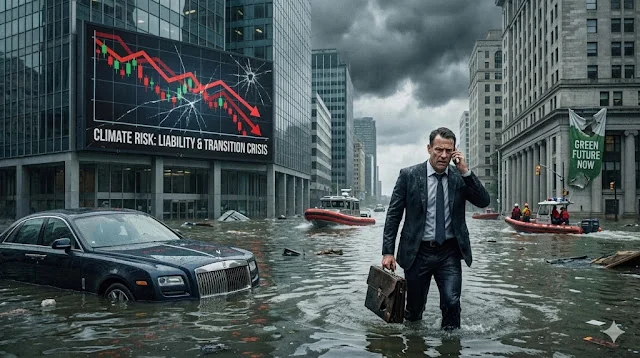
The global financial architecture is undergoing a tectonic shift. Climate change has metastasized into a central driver of financial instability. For ESG professionals and CROs, the era of voluntary commitments is closing, replaced by mandatory disclosure and severe legal accountability.
On this page
- A Comprehensive Framework for Financial Resilience in the Poly-Crisis Era
- Part I: The New Climate Regime – From Voluntary to Mandatory
- Part II: Physical Risk – The Kinetic Threat
- Part III: Transition Risk – The Cost of Decarbonization
- Part IV: Operational Risk – Disruption of the Value Chain
- Part V: Liability Risk – The Courtroom as a Battleground
- Part VI: Reputational Risk – The Valuation of Trust
- Part VII: Integrated Mitigation Strategies
- Conclusion: The Resilience Imperative
- Key Data Summary Tables
A Comprehensive Framework for Financial Resilience in the Poly-Crisis Era
Part I: The New Climate Regime – From Voluntary to Mandatory
1.1 The Evolution of the Risk Framework
The lexicon of climate risk has been formalized through the TCFD and now the ISSB standards (IFRS S1 and S2). In 2025, the landscape shifted with the adoption of IFRS S2, elevating climate reporting to a global baseline. Companies must now disclose quantitative financial impacts—transforming risk assessment from a voluntary exercise into a regulatory imperative.
1.2 The Poly-Crisis and Interconnectivity
Risks rarely occur in isolation. They form a "poly-crisis." A physical shock often acts as the first domino, toppling operational stability, which triggers market and liability consequences.
Part II: Physical Risk – The Kinetic Threat
Physical risk refers to the "kinetic" manifestations of a warming planet. As temperatures rise, damage costs escalate non-linearly.
2.1 Acute Risks (The Shocks)
Event-driven shocks like hurricanes and floods. The critical theme is the "Insurance Retreat" in high-risk zones, transforming transferred risks into balance sheet exposures.
2.2 Chronic Risks (The Stressors)
Long-term shifts like heat stress and water scarcity. These are stressors that slowly degrade asset performance and labor productivity, acting as a tax on labor-intensive industries.
Table 1: Financial Transmission Channels of Physical Risk
| Statement Item | Impact Mechanism | Example Scenario |
|---|---|---|
| Revenues | Production interruptions; Supply chain delays. | Factory flooded, halting production; Q3 revenue miss. |
| Operating Costs | Higher insurance premiums; Increased utility costs. | Premiums triple; energy costs rise 20% due to heat. |
| Assets | Write-offs; Impairment due to uninsurability. | Warehouse deemed uninsurable and written down. |
| CapEx | Retrofit costs for resilience; Relocation. | Investing $10M in flood defenses. |
Part III: Transition Risk – The Cost of Decarbonization
The risk of being "wrong-footed" by the speed or direction of the green transition.
- Policy & Legal: Mechanisms like EU's CBAM turn carbon pricing into trade tariffs. Laws like California's AB 1305 mandate strict disclosure, penalizing violations heavily.
- Technology: New technologies displace old systems, creating stranded assets (e.g., ICE vehicles, gas boilers) and winner/loser dynamics.
- Market: Shifts in supply/demand. Volatility in critical minerals or demand destruction for carbon-intensive products.
Part IV: Operational Risk – Disruption of the Value Chain
Where theoretical models hit daily reality. Climate change is effectively "de-globalizing" supply chains by making logistics unreliable.
Operational risk also includes infrastructure failure (power grids failing under heat) and human capital issues (heat stress as a regulated occupational hazard).
Part V: Liability Risk – The Courtroom as a Battleground
Liability risk arises from the failure to mitigate or disclose risks. "Greenwashing" is now a central legal liability.
Part VI: Reputational Risk – The Valuation of Trust
Reputational risk amplifies operational or liability failures. It leads to the "Greenwashing Discount" on stock prices, talent flight, and the stigmatization of entire sectors, constraining access to capital.
Part VII: Integrated Mitigation Strategies
1. Parametric Insurance
Unlike indemnity, this pays out based on triggers (e.g., wind speed, river level). Provides immediate liquidity.
2. Supply Chain Audits (SMETA)
Visibility into Tier 2/3 suppliers is essential to mitigate operational and liability risks.
3. Quantitative Stress Testing
Use NGFS scenarios. Identify "break points" in the business model under high carbon prices or extreme heat.
4. Robust Disclosure
Treat ESG data like financial data. Internal controls and legal review of marketing claims are mandatory.
Conclusion: The Resilience Imperative
The distinction between "climate strategy" and "business strategy" is evaporating. The companies that thrive will be those that fundamentally restructure their asset bases and governance models.
Key Data Summary Tables
Table 2: The 5 Categories of Climate Risk
| Risk Category | Definition | Primary Financial Impact |
|---|---|---|
| Physical | Damage from climatic events. | Asset impairment, insurance costs. |
| Transition | Risks from shift to low-carbon. | Stranded assets, margin compression. |
| Liability | Legal risks from action/inaction. | Fines, settlements, forced disclosure. |
| Reputational | Loss of brand value/trust. | Revenue loss, "Greenwashing Discount". |
| Operational | Disruption to business processes. | Logistics surcharges, productivity loss. |
Table 3: Notable Financial Impacts (2023-2025 Data)
| Event / Case | Risk Type | Financial Impact |
|---|---|---|
| DWS Greenwashing | Liability/Reputation | €25m Fine + ~$1bn Market Cap Loss |
| Panama Canal Drought | Operational | $130-$297 surcharge per container |
| Red Sea/Africa Reroute | Ops/Transition | $400,000 extra emissions cost |
| Parametric Payout | Mitigation | $4m payout for heat >108°F |
No comments yet. Be the first.