Cascading Disasters: When One Hazard Triggers the Next
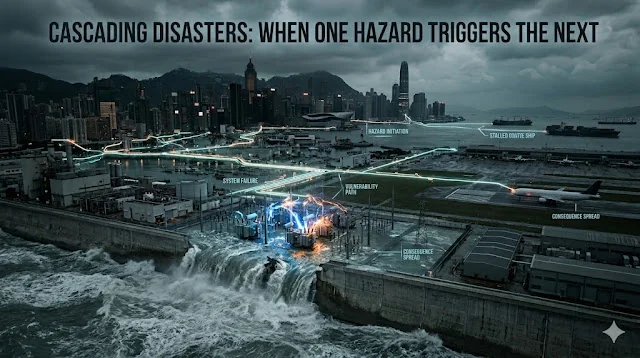
Why multi-hazard systemic risk—not single-event severity—now defines modern Disaster Risk Management (DRM).
On this page
Why multi-hazard systemic risk—not single-event severity—now defines modern Disaster Risk Management (DRM).
The date March 11, 2011, did not just record a magnitude 9.0 seismic shock off the coast of Tōhoku, Japan. It permanently shattered the linear paradigms that had long underpinned global Disaster Risk Management (DRM). What began as a tectonic subduction event transformed within minutes into a massive tsunami, which then over-topped the coastal defenses of the Fukushima Daiichi Nuclear Power Plant. This triggered a loss of core cooling, three reactor meltdowns, a radiological emergency, and a socio-economic cascade that disrupted global automotive and semiconductor supply chains for months.
For decades, risk frameworks evaluated vulnerabilities through siloed lenses. The conventional formulation expressed risk as a function of three terms—Risk = Hazard × Exposure × Vulnerability—yet in practice these were assessed one hazard at a time. Today, in a hyper-connected, urbanized, and digitally interdependent global system, hazards rarely act in isolation. As the United Nations Office for Disaster Risk Reduction (UNDRR) emphasizes, we have entered the era of systemic and cascading risk, where the most dangerous variable is no longer the hazard itself but the architecture of the connections we have built around it.
1
Theoretical Framework: The Anatomy of a Cascade
To manage cascades, DRR professionals must first understand their structural physics. In the academic literature—pioneered by Gianluca Pescaroli and David Alexander at University College London—a cascading disaster is defined not as a sequence of unfortunate coincidences, but as a chain of interconnected failures whose severity is driven by vulnerability rather than by the triggering event. In their working definition, cascading effects are dynamics in which the impact of a physical event, or an initial technological or human failure, generates a sequence of events in human subsystems that result in physical, social, or economic disruption.
Crucially, Pescaroli and Alexander reject the popular "toppling dominoes" metaphor. Dominoes fall in a simple, predictable, linear line. Real cascades branch, amplify, and jump across sectors—electricity into water, water into telecommunications, telecommunications into finance—in ways no single chain can capture. This distinction is the conceptual heart of the field.
Sequential Dynamics
Cascading Disasters
Events unfold chronologically over time. One failure explicitly generates the next through critical infrastructure interdependencies (e.g., loss of power → water pump failure → loss of potable water).
Simultaneous Dynamics
Compound / Concurrent Disasters
Multiple distinct hazards overlap in the exact same spatial and temporal window, actively amplifying societal vulnerability simultaneously (e.g., heatwave + power outage during a pandemic).
Systemic Risk
Risk endogenous to a system—built into the network's own design. In an efficiency-optimized world, the pursuit of lean operation routinely sacrifices the redundancy that absorbs shocks.
Interdependency Paths
Non-linear failure routes where a single grid collapse can simultaneously disable water pumping, telecommunications, and financial settlement—Pescaroli and Alexander's "vulnerability paths".
Escalation Points
Critical junctures where the interaction of vulnerabilities produces an impact greater than reaction to the primary hazard alone would suggest. Alexander notes an escalation point can become a larger source of damage than the initial trigger.
2
Deep-Dive Global Case Studies
To build systemic resilience, we must move past generic disaster descriptions and analyze the structural failure mechanics inside complex networks. Each case below is categorized by its core risk dynamics, and—rather than merely listing what happened—names the specific interdependency mechanism that turned a contained event into an expanding emergency.
Cascading — Triple Disaster
Case Study 1: The Great East Japan Earthquake (2011)
A sequential socio-technical cascade in which each sub-system failure directly incapacitated the safety barriers of the next node.
The interdependency mechanism — common-cause failure: Nuclear safety design assumes that primary and backup power are independent, so that no single event can disable both. At Fukushima Daiichi that assumption collapsed. A single hazard—the tsunami—simultaneously cut the off-site grid connection and flooded the on-site emergency diesel generators and switchgear housed in low-lying locations. Because the same wave defeated every layer at once, the redundancy was illusory. The result was a total Station Blackout (SBO): with no power to circulate coolant, the cores overheated and melted down. This is the textbook escalation point—the moment the event crossed from a managed seismic emergency into an unmanaged radiological one.
Cascading — Logistical Freeze
Case Study 2: Eyjafjallajökull Volcanic Eruption (2010)
A geophysical-to-economic cascade in which a localized natural event triggered an immediate, systemic halt in global transport.
The interdependency mechanism — absent buffers in a Just-In-Time network: The eruption itself destroyed almost nothing on the ground. The damage propagated through a single dependency: modern manufacturing and trade rely on Just-In-Time (JIT) logistics, in which airspace functions as a continuous moving warehouse rather than a buffered network with local stock. When precautionary airspace closures removed that moving warehouse, there was no inventory cushion to fall back on, so the disruption jumped instantly from Icelandic airspace to pharmaceutical supplies, perishable exports, and assembly lines across continents. The escalation point was regulatory, not physical—the decision threshold at which ash-concentration risk forced a near-total closure.
Cascading + Compound — Socio-Technical Collapse
Case Study 3: Hurricane Katrina, USA (2005)
A hybrid event in which physical infrastructure failure and systemic socioeconomic marginalization reinforced each other.
The interdependency mechanism — coupling of technical and social systems: The engineering cascade is straightforward: storm surge overtopped and breached an aging levee network designed to outdated assumptions, flooding roughly 80% of the city. But the catastrophe became socio-technical because the evacuation plan implicitly assumed private car ownership, while a large share of residents had none. The technical failure (flooding) and the social vulnerability (immobility) were not independent problems running in parallel—each amplified the other: flooding trapped exactly the population the plan had failed to move, while the loss of power and communications disabled the institutions meant to rescue them. This coupling is why Katrina sits at the boundary of cascading and compound dynamics.
3
Quantifying the Chain: Alexander's Cascading Magnitude Scale
To mitigate cascading hazards, DRR professionals must look beyond single-hazard intensity metrics such as the Moment Magnitude or Saffir–Simpson scales, which measure the energy of the trigger rather than the reach of its consequences. David Alexander (2018) proposed a dedicated magnitude scale for cascading incidents, crises, and disasters, defining "magnitude" here as size, geographical extent, richness of connections, complexity, and—as impacts propagate—duration.
Critically, Alexander designed the scale as a semantic tool for characterizing events, not a quantitative network metric. Assigning a level requires expert judgement, particularly about how far down a cascade chain it is useful to trace before further links stop being germane. The defining variable across levels is not geography but the presence, number, and reach of escalation points and cross-sectoral vulnerability interactions.
Level 0 — Simple Incident
No significant cascade or escalation point. Simple, direct, linear cause-and-effect; localized and brief, with no meaningful knock-on consequences.
Level 1 — Limited Complexity
Simple, short cascades—immediate "consequences of consequences"—but no escalation points and no major interactions beyond the early chain.
Level 2 — Some Complexity
Limited cascade chains reaching tertiary levels. Secondary emergencies may be as pressing as the primary event; escalation points may emerge as new vulnerability fields are penetrated.
Level 3 — Complex Disaster
Significant cascade chains with at least one escalation point. Distinct vulnerability sectors (physical, social, economic, institutional) interact identifiably, producing detectable compound consequences.
Level 4 — Substantially Complex
Easily identifiable cascades and escalation points that substantially prolong the emergency, with effects that may outlast or overshadow the initial trigger across many aspects of daily life.
Level 5 — Catastrophe
Long causal chains whose escalation points spawn secondary chains; concurrent compounding events occur. Disruption is very wide and long, with effects that are essentially global—intercontinental travel, international supply chains, global communications.
4
Strategic Shifts in Disaster Risk Management (DRM)
The Sendai Framework for Disaster Risk Reduction (2015–2030) explicitly challenges nations to understand risk in all its dimensions—including the interactions between hazards. For practitioners, operationalizing this means three structural transitions. The harder truth, learned in the field, is why each remains incomplete: not for lack of doctrine, but because institutional silos, fragmented budgets, and reluctance to share operational data keep organizations defending their own component rather than the system as a whole.
| Core Dimension | Old Paradigm | New Paradigm | Why It Stalls |
|---|---|---|---|
| Analysis Focus | Single-hazard, siloed frameworks | Multi-hazard & systemic risk design | Agencies are mandated and funded per hazard, not per system. |
| Operational Posture | Reactive crisis & emergency response | Proactive mitigation & functional decoupling | Prevention budgets compete with—and lose to—visible response spending. |
| Infrastructure Design | Rigid, component-level resistance | Adaptive, decentralized resilience & redundancy | Efficiency targets penalize the spare capacity resilience requires. |
Conclusion: Designing for a Resilient Future
True resilience begins by accepting that systems will inevitably be shocked. The objective of modern Disaster Risk Management is therefore not to prevent every fall, but to ensure that when one domino tips, it meets a structural break engineered to absorb the energy, isolate the failure, and preserve human life and societal continuity. The lessons of Tōhoku, Eyjafjallajökull, and Katrina converge on a single imperative: we must stop planning only for the disaster we expect, and start designing systems that can survive the connections we've already built.
References
- Alexander, D. E. (2018). A magnitude scale for cascading incidents, crises and disasters. International Journal of Disaster Risk Reduction, 30, 180–185. https://doi.org/10.1016/j.ijdrr.2018.03.006
- Pescaroli, G., & Alexander, D. (2015). A definition of cascading disasters and cascading effects: Going beyond the “toppling dominos” metaphor. GRF Davos Planet@Risk, 3(1), 58–67.
- Pescaroli, G., & Alexander, D. (2018). Understanding compound, interconnected, interacting, and cascading risks: A holistic framework. Risk Analysis, 38(11), 2245–2257. https://doi.org/10.1111/risa.13128
- UNDRR. (2022). Global Assessment Report on Disaster Risk Reduction (GAR2022): Our World at Risk. Geneva: United Nations Office for Disaster Risk Reduction.
No comments yet. Be the first.