Ecosystem-Based Disaster Risk Reduction: Scaling Models and Evidence from Five Countries
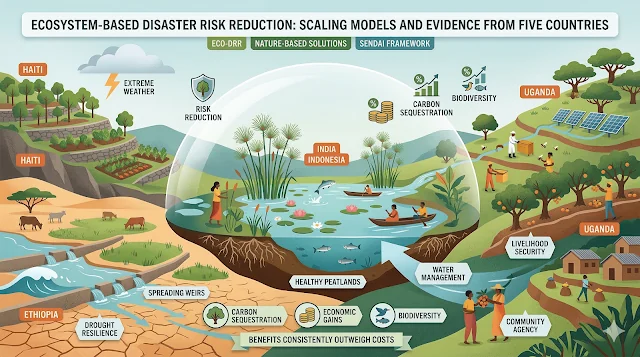
Findings synthesized from field projects implemented in India, Uganda, Indonesia, Haiti, and Ethiopia by UNEP and the Partners for Resilience (PfR) consortium demonstrate the transformation of the Eco-DRR approach from a technical domain into an integrated philosophy of resilience.
On this page
Tags: Eco-DRR · Nature-based Solutions
Ecosystem-Based Disaster Risk Reduction: Scaling Models and Evidence from Five Countries
Findings synthesized from field projects implemented in India, Uganda, Indonesia, Haiti, and Ethiopia by UNEP and the Partners for Resilience (PfR) consortium demonstrate the transformation of the Eco-DRR approach from a technical domain into an integrated philosophy of resilience.
168K+
Beneficiaries
135% of target
33K
Hectares Restored
132% of target
193
CBOs Strengthened
150% of target
5
Countries
Asia·Africa·Caribbean
Context
Why Eco-DRR Now?
Environmental degradation exacerbates disaster risk; conversely, ecosystem management and restoration build community resilience against disasters. This principle is the cornerstone of the Ecosystem-based Disaster Risk Reduction (Eco-DRR) project, implemented in five countries by the UNEP and Partners for Resilience (PfR) consortium with support from the European Commission.
"Ecosystems provide disaster risk reduction services, thereby contributing to the resilience of local communities against disasters and climate change."
Over the last decade, Nature-based Solutions (NbS) have gained an increasingly central role in international disaster risk reduction policies, particularly within the Sendai Framework. The fifth UN Environment Assembly consolidated the global legitimacy of this approach by adopting a multilaterally agreed definition of Nature-based Solutions.
Field Implementations
Five Countries, Five Models
Each country adapted three core components—ecosystem restoration and protection, disaster risk reduction, and climate-smart livelihoods—to formulate a context-specific model.
Wetland Diplomacy
India
In the catchments of Kabar Taal in Bihar and Tampara Lake in Odisha, 3,300 hectares of wetlands were protected or restored, with both subsequently achieving Ramsar Site status. An NbS Guide for disaster managers was developed with NDMA for integration into district-level plans.
Key Lesson: Wetlands often trail behind forests in the development agenda; institutional training curricula can bridge this gap.
Catchment Management
Uganda
Implemented across 6 micro-catchments in the Aswa River basin featuring apiaries, Shea tree enterprises, and solar-powered irrigation. Integrating Village Savings and Loan Associations (VSLA) with Eco-DRR initiatives effectively managed the compound crisis during COVID-19.
Key Lesson: Updating national irrigation guidelines to include micro-catchment planning is a crucial scaling outcome.
Peatland Restoration
Indonesia
In North Sumatra, the biorights approach offered conditional micro-credits to community groups; loans convert to grants upon 75% agreement completion. Established an 83-canal water level monitoring infrastructure and fire early warning systems.
Key Lesson: Market-based incentive mechanisms effectively unite long-term ecosystem protection with community agency.
Drought-Resilient Tech
Ethiopia
Constructed water spreading weirs for pastoralist communities in the Somali Region. This restored rangelands during the 2021 drought (which killed 500,000+ livestock locally) and achieved integration into the national PSNP program.
Key Lesson: With 80% of the land facing severe erosion, Eco-DRR offers a proven solution scalable to the national level.
Intersection of Humanitarian Aid and Development
Haiti
The South Department produces 41% of the nation's charcoal; deforestation exacerbates disaster risk while remaining a primary income strategy for poor households. Interventions merged good agricultural practices, tree planting, and women's vegetable gardening. Crucially, hybrid grey-green solutions successfully prevented flood damage in the epicenter of the 2022 earthquake.
Key Lesson: The traditional "combit" participation mechanism proved critical in sustaining the project amidst COVID-19 and political instability.
41%
National Charcoal Output from South Dept.
Economic Analysis
Cost-Benefit Analysis (CBA)
An independent analysis conducted by the University of Massachusetts Amherst revealed that Eco-DRR interventions consistently outweighed costs across all project sites. The analysis utilized a 7% discount rate, with robustness testing at 3%, 7%, and 10%.
| Scenario | Description | Result |
|---|---|---|
| Baseline | No Eco-DRR intervention | Reference point for comparison |
| Scenario 1 | Eco-DRR included, carbon sequestration excluded | Benefits exceed costs |
| Scenario 2 | Eco-DRR included, carbon sequestration included | Benefit-cost margin widens |
Quantified Direct Benefits
Carbon Sequestration — High Impact
Avoided Damages to Property & Livelihoods — High Impact
Agricultural Yield (honey, shea butter, fruit) — Medium-High Impact
Health Improvements (not fully monetized yet) — Potential
Challenges
Barriers to Scaling
Sectoral Fragmentation
Ecosystem management policies are often limited to superficial "beautification," diverging from genuine ecological integrity.
Resistance to Proactive DRR
Communities and local authorities still frequently favor reactive relief packages over preventative Eco-DRR measures.
Measurement Challenges
Accurately identifying landscape-level restoration areas and continuous monitoring requires mandatory GIS expertise.
Financing Under Compound Risks
Simultaneous crises, such as COVID-19 intersecting with natural hazards, severely strain community capacities and financial resources.
Policy & Practice
Recommendations from Five Countries
1 Design Monitoring from Inception
Gathering baseline data at the project's onset strengthens the reliability of CBAs and scaling arguments. The UMass Amherst analysis specifically highlighted this gap.
2 Integrate into Established Government Programs
Large-scale programs like the PSNP (Ethiopia), District Disaster Management Plans (India), and National Catchment Planning (Uganda) are the primary levers for Eco-DRR sustainability.
3 Strengthen Market-Based Restoration
Addressing the entire value chain (e.g., honey production) permanently incentivizes community members to protect ecosystems. The biorights model concretely proved this.
4 Center Women's Leadership
High participation rates at the level of women's self-help groups and local committees across all countries prove that Eco-DRR is an effective vehicle for advancing gender equality.
5 Explore Private Sector Financing
Corporate Social Responsibility (CSR) and carbon financing mechanisms remain largely untapped arenas for supplementing public budgets.
Conclusion
Nature, Our Greatest Ally
168,000+ beneficiaries, 33,000 hectares of restored land, and 193 capacity-strengthened CBOs—these figures represent 135%, 132%, and 150% of their respective targets. Eco-DRR unites disaster management, climate adaptation, ecosystem services, and socio-economic development into an integrated philosophy of resilience.
Investing in nature is the most efficient DRR investment.
Q&A
Frequently Asked Questions
What exactly is Eco-DRR and how does it differ from traditional DRR approaches?
Eco-DRR integrates ecosystem management and restoration directly into disaster risk reduction strategies. Unlike grey infrastructure-focused traditional DRR (dams, levees), it leverages nature's services — such as wetlands for flood buffering, forests for slope stabilization, or mangroves for coastal protection — while delivering co-benefits like livelihoods, biodiversity, and carbon sequestration. The UNEP-PfR projects show it as a "resilience philosophy" that combines DRR, climate adaptation, and socio-economic development.
Why do all five country examples focus heavily on water-related risks?
Water (excess or scarcity) is the most common risk driver across geographies: floods in Haiti/Indonesia, droughts in Ethiopia/Uganda, and seasonal extremes in India. Ecosystems naturally regulate hydrological cycles, making water-focused interventions (wetland restoration, catchment planning, water spreading weirs) highly effective and scalable entry points for Eco-DRR.
How economically viable are these Eco-DRR interventions according to the CBA?
The independent UMass Amherst analysis demonstrates that benefits outweigh costs in all sites, even under conservative assumptions (7% discount rate, no full monetization of health benefits). Including carbon sequestration widens the benefit-cost margin significantly. Net positive returns appear by year 5 in Haiti/India and by year 10 in Indonesia/Uganda.
Can these models be scaled or adapted outside the five countries?
Yes — the core principles (ecosystem restoration + DRR integration + climate-smart livelihoods) are adaptable across different regions and hazards. Key enablers include strong baseline monitoring, integration into existing government programs (like PSNP in Ethiopia), market-based incentives (biorights in Indonesia), and women's leadership. Starting small with pilot catchments or wetlands often works best to overcome universal challenges like sectoral silos.
What are the biggest barriers to wider adoption of Eco-DRR globally?
The primary barriers identified are:
1) Sectoral fragmentation (environment vs. disaster management ministries).
2) Preference for reactive relief over proactive prevention.
3) Data and measurement gaps, particularly the need for GIS and long-term monitoring.
4) Financing challenges under compound risks (e.g., managing pandemics alongside natural hazards).
How can practitioners or policymakers get involved or replicate these approaches?
Start by reviewing the UNEP-PfR resources and the full CBA paper. The next step is integrating these concepts into national plans, such as Sendai-aligned strategies or National Biodiversity Strategies and Action Plans (NBSAPs). For funding, explore mechanisms like carbon credits, CSR, or bilateral donors. Ensuring community ownership through models like VSLA, biorights, or "combit" is vital for long-term sustainability.
Is there any gender or equity dimension in these projects?
Absolutely. Women's leadership was central to success across the board—from vegetable gardening groups in Haiti to high participation rates in VSLAs in Uganda. While the equity analysis in the CBA highlights these inclusive benefits, gathering more explicit gender-disaggregated data will further strengthen future evaluations.
Source: This article is synthesized from my personal notes and key takeaways gathered while attending the "Upscaling Community Resilience through Ecosystem-based Disaster Risk Reduction" webinar (October 13, 2022) organized by UNEP and the Partners for Resilience consortium (Wetlands International, Netherlands Red Cross, Care International, Cordaid), alongside the University of Massachusetts cost-benefit analysis.
No comments yet. Be the first.