The New Era of Disaster Risk Management
On this page
How AI, Digital Twins, IoT, and Nature-Based Solutions Are Revolutionizing Global Resilience
1. Technological Deep Dive
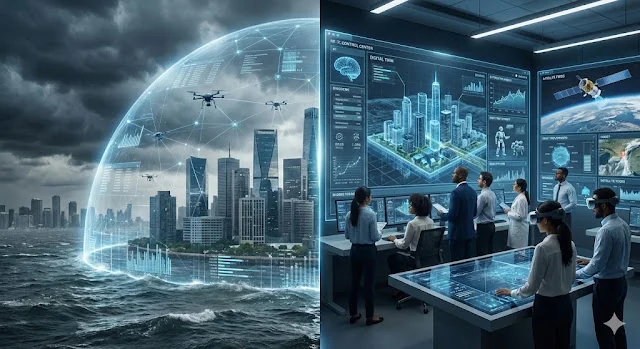
The last five years have marked a profound transformation in how disasters are predicted, monitored, and mitigated. Central to this revolution are Digital Twins (DTs), AI-driven predictive models, and IoT sensor ecosystems that allow real-time risk visualization and intervention.
Digital Twins: Real-Time Simulation for Critical Infrastructure
A Digital Twin is a virtual, continuously updated replica of a physical system — from bridges to entire cities — created by integrating sensor data, simulations, and AI algorithms. In Korea’s Seohae Bridge Project, a digital twin integrated BIM-based 3D models, UAV inspections, and AI monitoring, reducing response time by 40% and improving prediction accuracy by 30% (Gil & Kang, 2025).
Japan’s City Digital Twin Flood Visualization project merged drones and AR simulations to create real-time flood visuals, enhancing situational awareness and speeding up response times by 20% (Kikuchi et al., 2022).
“Digital Twins turn static data into living systems — constantly learning, predicting, and optimizing response.”
2. AI-Driven Predictive Modeling
AI-driven forecasting now relies on neural networks trained on decades of sensor and climate data. Explainable AI (XAI) enables understanding of AI decisions, reducing false alarms.
A 2023 systematic review found that integrating XAI in disaster management reduced false positives by 20% in flood alerts (Ghaffarian et al., 2023).
3. Best Practice Examples
Denmark: HIP Digital Twin
The Hydrological Information and Prediction (HIP) system combines hybrid ML and hydrological calibration. During the 2022 North Sea floods, it improved warning precision by 28% (Henriksen et al., 2022).
Japan: City Digital Twin for Flood Visualization
The Osaka Flood Twin integrated drones and AR to visualize inundation and cut evacuation planning time by 18 hours.
Italy: Territorial Digital Twins
Italy’s initiative applied GIS mapping and photogrammetry in Alpine regions to improve community resilience, increasing preparedness by 35% (Chioni et al., 2023).
4. Nature-Based Solutions: Technology Meets Ecology
Cities like Rotterdam, Singapore, and Copenhagen combine green infrastructure with IoT sensors. Copenhagen’s Cloudburst Plan uses AI-based hydraulics and green corridors to cut flood events by 40%.
Rotterdam’s Blue-Green Roofs use IoT valves to manage rainwater in real-time, balancing flood prevention and ecosystem health.
5. Challenges and Ethics
Data Privacy & Cybersecurity
Disaster apps often handle sensitive geolocation data. The EU NIS2 Directive (2022) mandates zero-trust architectures for digital twins (Coppolino et al., 2023).
Algorithmic Bias & False Positives
False positive rates in AI flood alerts can reach 25%, creating alert fatigue among responders (Ghaffarian et al., 2023).
Economic Barriers
Digital Twin integration costs $5–10M per deployment, yet yields 60% maintenance savings (Ogunmolu, 2025).
6. Conclusion
Disaster Risk Management is evolving into a synergy of data, digital twins, and nature. From AI-driven forecasting in Denmark to AR-based simulations in Japan, technology is becoming predictive, transparent, and ethical.
“The real revolution in disaster risk management isn’t about replacing nature with data — it’s about teaching data to understand nature.”
No comments yet. Be the first.