Türkiye's Disaster Management Framework: TARAP, TAMP, and TASİP Explained
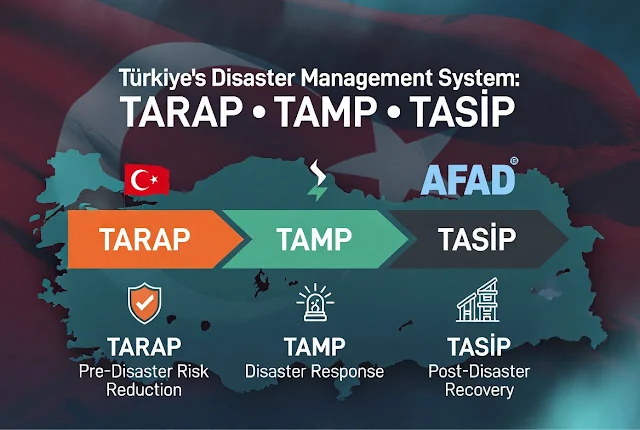
A fact-checked guide decoding the national system Türkiye uses to manage its disaster cycle — three plans under a single strategic umbrella, coordinated by AFAD, with primary-source figures, legal citations, and their place within the Sendai Framework for Disaster Risk Reduction.
On this page
- 1. The Legal and Institutional Foundation
- 2. The Three-Plan Disaster Cycle
- 3. Pre-Disaster: TARAP and the Provincial İRAPs
- 4. During Disaster: TAMP's Response Architecture
- 5. Post-Disaster: TASİP and Long-Term Recovery
- 6. TARAP and the Sendai Framework: How the Priorities Map
- 7. Lessons from the Field: 2020 İzmir and 2023 Kahramanmaraş
- 8. A Brief International Comparison
- Frequently Asked Questions
- Conclusion
Disaster Risk Management · Türkiye
A fact-checked guide decoding the national system Türkiye uses to manage its disaster cycle — three plans under a single strategic umbrella, coordinated by AFAD, with primary-source figures, legal citations, and their place within the Sendai Framework for Disaster Risk Reduction.

Last fact-checked: July 2026. All statistics below are sourced to AFAD, the Turkish Official Gazette, and peer-reviewed journal articles; every DOI was individually resolved before publication (see References).
1. The Legal and Institutional Foundation
Before the three plans, there is a chain of command and a chain of legislation that international readers usually miss.
AFAD sets policy and coordinates nationally, while each of Türkiye's 81 provinces has its own AFAD provincial directorate that executes operations locally under the province's governor. It's more accurate to describe this as centralized policy design with governor-led local execution than as a single unbroken chain of command — a distinction that matters for anyone comparing it to a more devolved system like the United States' FEMA-state-local model.
Importantly, TARAP, TAMP, and TASİP are not the top of the pyramid. All three sit beneath a national umbrella document — the Türkiye Disaster Management Strategy Document and Action Plan — which sets the overall direction that the pre-disaster, response, and recovery plans then implement.
2. The Three-Plan Disaster Cycle
| Phase | Plan | In force since | Legal instrument |
|---|---|---|---|
| Pre-disaster | TARAP — Türkiye Disaster Risk Reduction Plan | 8 July 2022 | Official Gazette No. 31890 / Presidential Decision No. 5787 |
| During disaster | TAMP — Türkiye Disaster Response Plan | Issued 2014, revised 2022 | Official Gazette No. 28871 (2014) → No. 31954 (2022) |
| Post-disaster | TASİP — Türkiye Post-Disaster Recovery Plan | 24 May 2025 | Presidential Decision No. 9889 |
3. Pre-Disaster: TARAP and the Provincial İRAPs
İRAP: the provincial layer
TARAP is built from the bottom up. Each of the 81 provinces first produced its own Provincial Disaster Risk Reduction Plan (İRAP), and these were consolidated to inform TARAP's national goals and actions. A detail worth flagging for comparative researchers: the provincial plans work across 26 hazard types — a broader list than TARAP's 11 — reflecting local hazards (such as land subsidence in specific basins) that don't rise to national-plan status but matter enormously at the provincial level. In their first (2021) iteration, the İRAPs collectively defined roughly 222 goals, 1,364 objectives, and around 12,900 actions across the 81 provinces; these figures are revised periodically as provinces update their plans. Provincial Monitoring and Evaluation Boards are responsible for keeping each İRAP current.
Financing is the area where İRAP execution is evolving fastest, and where it's worth being precise about what already exists versus what is still emerging:
- A dedicated national fund is now in place. The Afet Yeniden İmar Fonu (Disaster Reconstruction Fund) was established to give post-2023 recovery spending a transparent, ring-fenced budget line, rather than leaving it to ad hoc annual allocations.
- Municipal-level matching mechanisms have a track record. The World Bank's long-running Istanbul Seismic Risk Mitigation and Emergency Preparedness Project (ISMEP) has used targeted grants — on the order of $2 million per municipality for equipment and digitization — that catalyzed municipalities to commit substantially larger sums of their own budgets in follow-on reforms, an approach independently reviewed by the World Bank's own evaluation group.
- Multilateral co-financing is scaling up, though currently concentrated on recovery rather than prevention. The World Bank's $650 million Istanbul Resilience Project (approved August 2025) explicitly funds institutional capacity-building for provincial authorities, and the Council of Europe Development Bank has committed €1.2 billion toward ISMEP-related seismic retrofitting. Most of this financing, however, targets the 11 provinces affected by the 2023 earthquakes and greater Istanbul specifically, rather than routine, nationwide İRAP action items in provinces that haven't yet experienced a major disaster.
The natural next step — extending matching-grant and dedicated-fund models from post-disaster reconstruction and Istanbul-specific seismic risk toward routine, preventive İRAP execution nationwide — is a live policy conversation rather than a solved problem, and one where provincial coordinators are well placed to make the case for their own provinces.
4. During Disaster: TAMP's Response Architecture
5. Post-Disaster: TASİP and Long-Term Recovery
Between the point where search-and-rescue operations wind down and permanent reconstruction begins sits a transitional phase — temporary shelter, debris removal, and interim livelihoods — that draws on both TAMP and TASİP without sitting neatly inside either. As TASİP's implementation matures, clarifying the handover mechanics for this "early recovery" window is a natural area for further institutional development.
6. TARAP and the Sendai Framework: How the Priorities Map
TARAP states that it aligns with the Sendai Framework for Disaster Risk Reduction 2015–2030. Here is a working alignment between Sendai's four priorities and where TARAP's own goal structure addresses them:
| Sendai Priority | How TARAP Addresses It |
|---|---|
| 1. Understanding disaster risk | Hazard-specific goals across all 11 disaster types; İRAP-level risk mapping feeding into the national plan. |
| 2. Strengthening governance to manage risk | Named responsible/supporting institutions for each of the 227 actions; Provincial Monitoring and Evaluation Boards. |
| 3. Investing in resilience | Short/medium/long-term action horizons (2022–2024 / 2022–2028 / 2022–2030) tied to resourcing decisions. |
| 4. Enhancing preparedness for effective response ("Build Back Better") | Handoff to TAMP for response and TASİP for recovery, explicitly using Build-Back-Better language. |
This mapping is an analytical synthesis for this article; TARAP's own text organizes its priorities using Sendai's language but does not publish a one-to-one crosswalk table.
7. Lessons from the Field: 2020 İzmir and 2023 Kahramanmaraş
Two earthquakes dominate recent Turkish disaster-management literature: the 30 October 2020 İzmir (Samos) earthquake and the twin 6 February 2023 Kahramanmaraş earthquakes. It's worth being precise about magnitude and mechanism, since this is where popular coverage tends to blur technical distinctions that structural engineers treat as quite separate.
- The İzmir earthquake measured approximately Mw 6.9.
- The Kahramanmaraş sequence consisted of two major shocks of approximately Mw 7.7 and Mw 7.6, roughly nine hours apart — an unusual double-rupture event that stressed already-damaged structures a second time before rescue operations were complete.
Two distinct technical issues are often conflated in non-specialist writing about the 2023 collapses:
- Site amplification and micro-zonation — soft or poorly characterized soil can amplify shaking intensity at the surface; this is a site-selection and zoning issue, addressed through hazard microzonation mapping and reflected in the 2018 national seismic hazard map.
- Structural failure mechanisms — independent of soil conditions, the 2023 collapses have been linked to soft-story (weak ground-floor) configurations, inadequate transverse (confinement) reinforcement, substandard concrete quality, and construction that predated or evaded the current Turkish Building Earthquake Code (TBDY 2018).
Treating these as a single "poor ground-building harmony" phenomenon understates the case; the two need to be assessed and mitigated through different tools — zoning and site investigation on one hand, code enforcement and retrofitting on the other.
8. A Brief International Comparison
For readers evaluating Türkiye's system against other national frameworks: Türkiye's model bears some resemblance to the United States' three-phase mitigation/response/recovery structure under FEMA's National Response Framework, though the US system is more devolved to states, whereas TARAP/TAMP/TASİP are drafted and issued centrally by AFAD with provincial execution. On international disaster response, Türkiye's Search and Rescue teams operate within the INSARAG classification system used to coordinate cross-border urban search-and-rescue deployments, and Türkiye participates in mechanisms comparable to the EU's Civil Protection Mechanism for regional mutual aid, though as a non-EU member Türkiye's participation runs through separate bilateral and NATO-adjacent channels rather than the EU mechanism itself.
Frequently Asked Questions
What does TARAP stand for and when did it take effect?
TARAP is the Türkiye Disaster Risk Reduction Plan (Türkiye Afet Risk Azaltma Planı). It took effect on 8 July 2022 and runs through 2030.
What is the difference between TAMP and TARAP?
TARAP governs pre-disaster risk reduction and mitigation. TAMP (Türkiye Disaster Response Plan) governs the active emergency-response phase once a disaster occurs.
Is TASİP legally binding?
TASİP was issued via a Presidential Decision, which binds the public institutions it names as responsible or supporting parties. It functions as a governing framework rather than as legislation directly binding on private citizens or businesses.
Who coordinates disaster management in Türkiye?
AFAD (the Disaster and Emergency Management Authority), operating under the Ministry of Interior, sets national policy; each of the 81 provinces has an AFAD directorate that executes operations locally under the provincial governor.
How is Türkiye financing provincial disaster-risk-reduction (İRAP) actions?
Through a mix of the national Afet Yeniden İmar Fonu (Disaster Reconstruction Fund), municipal-level matching grants such as those used in the World Bank's ISMEP project, and multilateral loans from institutions like the World Bank and the Council of Europe Development Bank — though most large-scale financing to date has concentrated on the 2023 earthquake-affected provinces and Istanbul rather than nationwide preventive action.
Conclusion
Türkiye's disaster management architecture has matured substantially since AFAD's creation in 2009, moving from a single response-focused agency toward a three-plan cycle nested under a national strategy document, explicitly referencing the Sendai Framework. Each plan has its own areas of active development: TARAP's strength is its granular, dated action list, though provincial-level financing is still catching up to provincial-level ambition, with dedicated funds and multilateral grants so far concentrated on post-disaster provinces rather than nationwide prevention; TAMP's academic reviewers point to coordination refinements worth making between service groups; and TASİP is too new to have a track record yet, with its relationship to older reconstruction law still settling into place. For international DRM practitioners, the more useful frame is not "how good is Türkiye's system" in the abstract, but which of these three plans, and which specific mechanism within it, is relevant to the comparison being made.
References
- AFAD (Disaster and Emergency Management Authority) <em>Türkiye Afet Risk Azaltma Planı (TARAP), 2022–2030.</em> Official Gazette No. 31890, 8 July 2022; Presidential Decision No. 5787.
- AFAD <em>Türkiye Afet Müdahale Planı (TAMP).</em> Official Gazette No. 28871, 3 January 2014; revised, Official Gazette No. 31954, 15 September 2022.
- AFAD <em>Türkiye Afet Sonrası İyileştirme Planı (TASİP).</em> Presidential Decision No. 9889, 24 May 2025.
- Aras, M., & Tetik Biçer, Ç. (2025) The Role of Communication in Disaster Management Strategic Plans: The Examples of TARAP, TAMP and TASİP. <em>Afet ve Risk Dergisi, 8</em>(3), 1247–1259. <span class="badge bg-success">Verified</span>
- Koç, F. (2024) Afet Yönetiminde Eşgüdüm Kapasitesinin Görünümü: Türkiye Afet Müdahale Planı (TAMP). <em>Memleket Siyaset Yönetim, 19</em>(43), 661–686. <span class="badge bg-success">Verified</span>
- Özmen, B., & Varol, N. (2024) 30 Ekim 2020 İzmir ve 6 Şubat 2023 Kahramanmaraş Depremlerinin Teknik ve Yönetsel Karşılaştırılması. <em>Afet ve Risk Dergisi, 7</em>(1), 319–328. <span class="badge bg-success">Verified</span>
- Varol, N., Kılıç Akıncı, S., & Dağlıoğlu, N. (2026) Türkiye Afet Müdahale Planı (TAMP) Kapsamında Afetzede Kimliklendirmesi: Adli Bilimlerin ve Yönetim Biliminin Rolü. <em>Afet ve Risk Dergisi</em>, (21). <span class="badge bg-success">Verified</span>
- Teker, Y., Bilgin, R., & Yildiz, A. (2026) Reflecting on the 6 February 2023, Türkiye-Syria earthquake: key lessons on disaster risk, response, and resilience. <em>Journal of Risk Research, 29</em>(1), 23–32. <span class="badge bg-success">Verified</span>
- World Bank. (2025) <em>World Bank Supports Istanbul's Disaster Resilience with New $650 Million Project.</em> <span class="badge bg-success">Verified</span>
- Independent Evaluation Group, World Bank Group <em>Reducing Risk Before Disaster Strikes: Seven Lessons from Turkey</em> (ISMEP project evaluation). <span class="badge bg-success">Verified</span>
- United Nations Office for Disaster Risk Reduction (UNDRR). (2015) <em>Sendai Framework for Disaster Risk Reduction 2015–2030.</em>
- Law No. 5902, Disaster and Emergency Management Presidency Organization and Duties Law (2009)
Frequently asked questions
What does TARAP stand for and when did it take effect?
TARAP is the Türkiye Disaster Risk Reduction Plan (Türkiye Afet Risk Azaltma Planı). It took effect on 8 July 2022 and runs through 2030.
What is the difference between TAMP and TARAP?
TARAP governs pre-disaster risk reduction and mitigation. TAMP (Türkiye Disaster Response Plan) governs the active emergency-response phase once a disaster occurs.
Is TASİP legally binding?
TASİP was issued via a Presidential Decision, which binds the public institutions it names as responsible or supporting parties. It functions as a governing framework rather than as legislation directly binding on private citizens or businesses.
Who coordinates disaster management in Türkiye?
AFAD (the Disaster and Emergency Management Authority), operating under the Ministry of Interior, sets national policy; each of the 81 provinces has an AFAD directorate that executes operations locally under the provincial governor.
How is Türkiye financing provincial disaster-risk-reduction (İRAP) actions?
Through a mix of the national Afet Yeniden İmar Fonu (Disaster Reconstruction Fund), municipal-level matching grants such as those used in the World Bank's ISMEP project, and multilateral loans from institutions like the World Bank and the Council of Europe Development Bank, though most large-scale financing to date has concentrated on the 2023 earthquake-affected provinces and Istanbul rather than nationwide preventive action.
No comments yet. Be the first.